"Driving Nigeria's future through innovation & action"
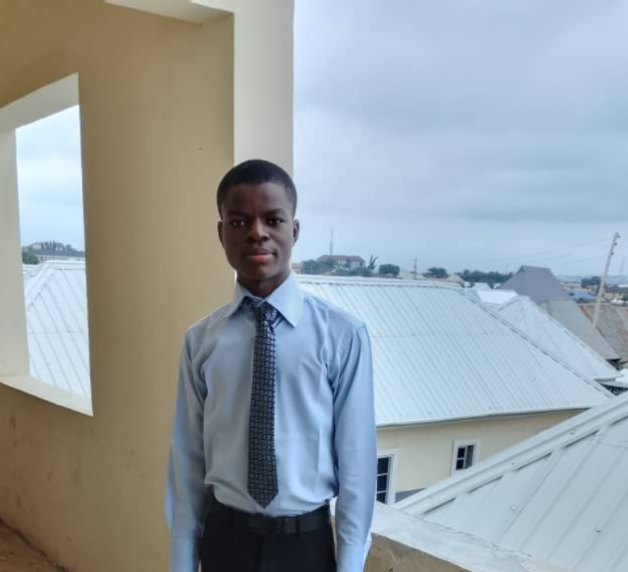
Kasimu Gaddafi Ali is a Nigerian accounting student, aspiring author, and advocate for industrialization, technological innovation, and national development. While pursuing his studies, he is passionate about using knowledge, strategy, and practical insights to empower youth and contribute to Nigeria's economic transformation.
He specializes in providing actionable insights on:
Gaddafi encourages fellow students, innovators, and policymakers to collaborate, share ideas, and take practical steps toward a stronger, self-reliant Nigeria.
For decades, petroleum stood as Nigeria's major source of revenue, defining our economic direction and determining our national strength. But today, the realities are changing. The oil sector no longer guarantees national stability. The revenues are shrinking, government earnings are inconsistent, and global energy transitions are reducing the dependence on crude oil.
To make matters clearer, the emergence of Dangote Refinery now the largest single-train refinery in the world has transformed Nigeria's petroleum landscape. Producing an estimated 1.2 million barrels per day, Dangote is set to dominate domestic refining. If the government continues to rely solely on external imports from companies like Shell and others, it will not only be unsustainable, but also unnecessary because, the private sector has taken over a terrain that once formed the backbone of the nation's income.
This is the truth many have refused to confront:
And so, Nigeria must look elsewhere toward industrialization.
Nigeria is one of the most naturally endowed nations on earth. Geological experts describe parts of Nigeria as “a summary of world geology”, a single country containing nearly every type of mineral the earth offers. Yet, we have spent years exporting raw materials and importing finished goods. This is the tragedy of an unindustrialized nation.
If Nigeria truly wishes to rise again, the government must venture boldly into full-scale industrialization not just on paper, not just in speeches, but in deliberate, strategic execution.
Among the many industries Nigeria can build steel, textiles, technology, automotive, pharmaceuticals ceramics stands out as one of the strongest, most profitable, and most promising.
The global demand for ceramics is enormous. As of 2024, projections show that the ceramics industry is valued well over 400 billion USD, with forecasts rising into the coming decades. This is not a temporary market, it is a growing one.
In Italy (the early global leader), ceramic production requires the combination of five different raw substances. In China (the present global giant), manufacturers need at least three added chemicals to produce a single ceramic product. But Nigeria is different. Our natural clay, just our clay is often enough to produce high-quality ceramic materials.
This means:
Ceramics are not going out of demand. Instead, they are becoming more essential. Plates, tiles, cups, sculptures, sanitary wares, electrical insulators, roofing tiles, industrial filters all these are ceramic-based.
And recently, Saudi Arabia announced plans to replace conventional road surfaces with ceramic-based materials. If this experiment succeeds, the world will follow. Which means:
Nigeria must position itself now as a world supplier.
If fully developed, the ceramics industry can:
The clay beneath our feet can rewrite our national destiny.
In the scale of preference for industrialization, ceramics should come first. Not because other industries are unimportant, but because ceramics offers:
Industrialization is not optional. It is the only path for Nigeria to rise again. And ceramics is the foundation stone of that path.
If Nigeria invests in ceramics—
If Nigeria develops its industries—
If Nigeria expands beyond petroleum—
then Nigeria will rise again, not as a consumer nation, but as a producer, a global competitor, and a true economic giant.
In this century, the true wealth of nations is no longer measured only by oil wells, farmlands, or mineral deposits. It is measured by innovation, technology, and digital platforms, the systems that shape modern human interaction, productivity, and national revenue. Globally, countries no longer rise by what they dig out of the ground but by what they build with their minds.
This is why Nigeria must embrace technology-driven industrialization, and one of the most critical areas in this transformation is application development.
However, there is a fundamental problem that Nigeria must first acknowledge:
This must change.
Let us take a simple example: WhatsApp.
WhatsApp is considered one of the lowest-earning major apps in the world, yet it still makes over a billion dollars annually from very small monetization.
If something this “small” can generate such wealth, Nigeria must understand the enormous digital opportunities we are missing.
Countries like China have proven that national digital independence is possible. In China:
They built:
And these platforms generate billions of dollars every year, not for foreigners, but for China. Why can't Nigeria do the same?
Nigeria has a population of over 300 million people (estimated). Even if only one-third(1/3) of the population uses a Nigerian-made digital platform, that is:
If each user generates even $0.30 USD per year (which is half of what WhatsApp earns), Nigeria would already have:
All generated from one single national app. This is the power of digital innovation, and this is only at $0.30 per user, an extremely small figure.
Nigeria has over 300 million people, yet less than 0.1% of us serve in the armed forces. Why? Because the military is underfunded, poorly equipped, and unable to guarantee strong welfare.
Dedicated digital revenue can solve this:
A consistent digital revenue stream can:
Technology companies generate massive employment:
A single national app can create tens of thousands of direct jobs and hundreds of thousands of indirect jobs.
Most crimes arise from:
But when innovation creates employment, crime naturally declines. A working nation is a peaceful nation.
WhatsApp is a “small” app in terms of revenue. But apps like YouTube, TikTok, Instagram Reels generate billions of dollars monthly.
If Nigeria creates even a scaled-down equivalent of these platforms, the revenue potential would be enormous,far exceeding WhatsApp's estimated $1.178 billion per year. Imagine:
Technology is not a luxury. It is not entertainment. It is not a “youth thing.” Technology is:
If Nigeria embraces digital innovation, app development, and technological nationalization:
Technology is the engine. Innovation is the fuel. Nigeria must drive.
If Nigeria wants to rise again, it must build and not to borrow the digital tools of the future. We must create our own apps, our own platforms, our own systems, and our own technological identity.
The future belongs to nations that use innovation to solve their problems, create wealth, and empower their people. Nigeria must be one of them.
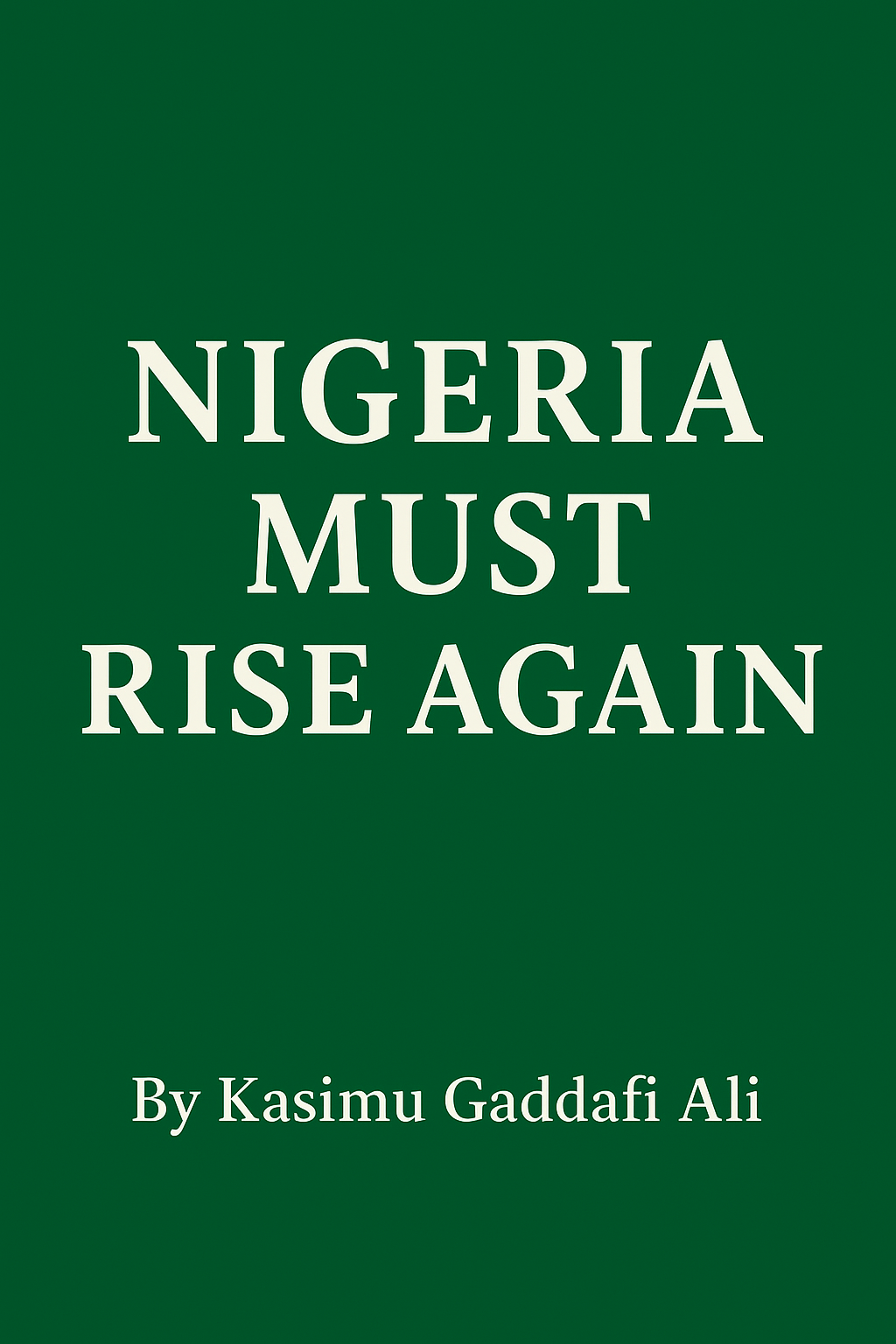
I pray that the government sees this book as a forward-looking analysis, a guide that could foster the rise of Nigeria in this new era. By embracing industrialization and technology, the nation can equip itself with the tools necessary for development, stability, and progress.
The benefits are clear:
These are the positive impacts that can reshape Nigeria.
I strongly believe that Nigeria can achieve this. I hope that everyone who reads this book gains insight, inspiration, and clarity on the path forward.
I am Kasimu Gaddafi Ali, and with the knowledge I have shared here, this is my vision for what Nigeria should do to achieve lasting progress.
Nigeria must rise again. We want a better country, not one plagued by poverty, terrorism, unemployment, or mismanagement. There is disaster at our doorstep, but there is also opportunity. We have the talent, the power, the capacity, and the resources necessary to rebuild our nation. Everything it takes to make Nigeria rise, to make it a livable, thriving country, is in our hands.
The future lies in our hands. With prayer, consistency, and determination, we can make this dream a reality. Without action, even the best future remains out of reach. But with clear purpose, Nigeria's future is bright.
This book represents a simple and analytical strategy for understanding the steps Nigeria must take. More ideas and insights will follow soon—so anticipate them.
Thank you.
Kasimu Gaddafi Ali